
 All in one
 AIR
 EDGE
 Canvas
 Grid
 Magix Nexo
 VISTA
 Pulse Pro
 Ready S
 Magix Cube
 Slim
 Cartridges
 Base 2
 Core S1
 Batteries
 Vape Filter









World Tobacco Development Report 2025 Vape Become New Regulatory Focus
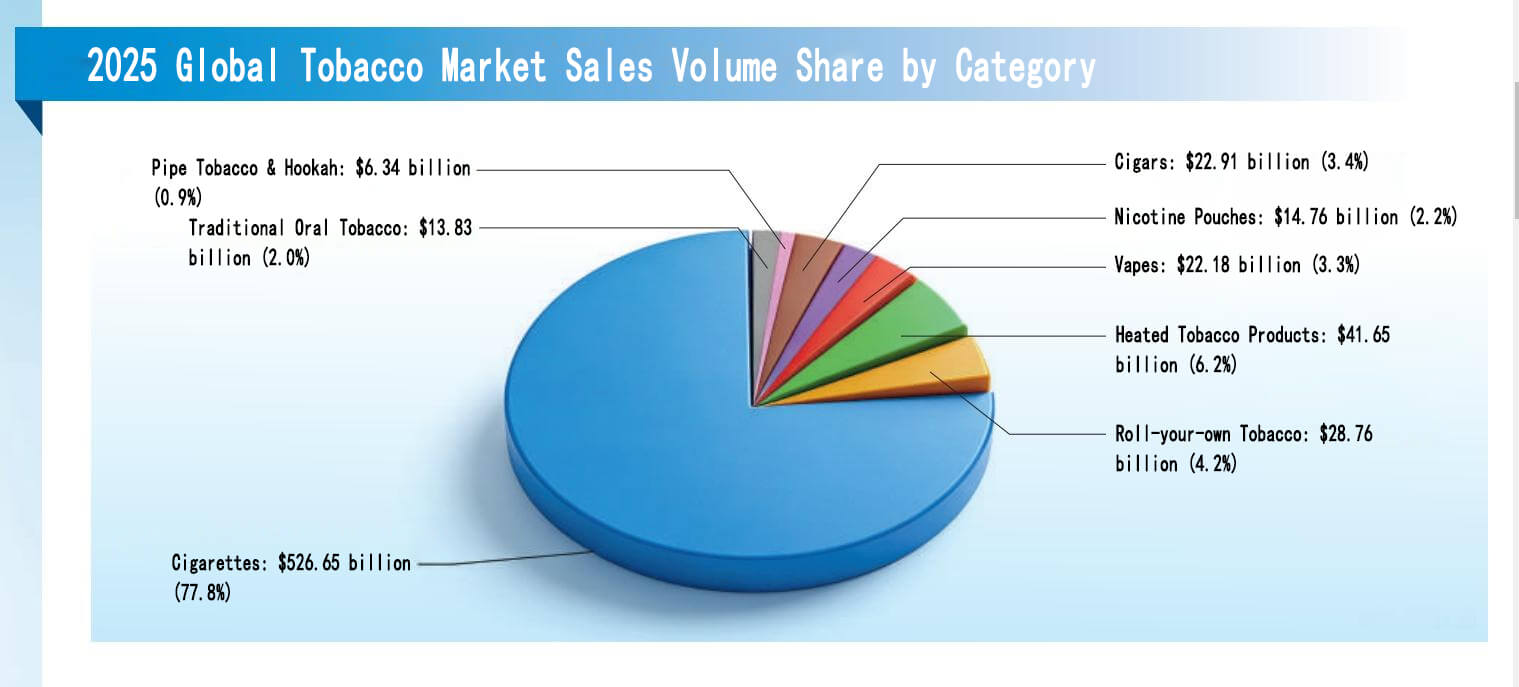
According to the Chinese tobacco website Eastobacco. In 2025, the global tobacco market sales will be 677.08 billion US dollars (all statistical data in this paper exclude Chinese Mainland), with a year-on-year growth of 3.8%, mainly supported by price increase and category structure upgrading. From a longer-term perspective, from 2010 to 2025, the tobacco market's sales revenue has accumulated a growth rate of 27.0%, with an average annual compound growth rate of about 1.6%. Although there have been short-term corrections in some years due to exchange rate or market fluctuations, the overall market still maintains a stable upward trend, reflecting strong price resilience against the backdrop of continuous contraction in cigarette sales. In terms of category, traditional cigarettes are still the basic market, accounting for 77.8% of sales revenue; The total sales of new tobacco products accounted for 11.7%, with nicotine pouches becoming the fastest-growing category with a growth rate of 31.4%. Heated cigarettes are steadily expanding, and vapes are entering an integration period under stricter regulation. In terms of regulatory policies, traditional cigarette regulation continues to strengthen, and vapes and nicotine pouches have become new regulatory focuses; Simultaneously implementing regulatory tools such as taxation, admission, and law enforcement; The dynamic evolution of regulatory environments in the United States and the European Union is becoming more complex.
Various tobacco products
The growth of global tobacco market sales in 2025 is mainly driven by price increases and category structure upgrades. The market presents a hierarchical pattern of "cigarettes as the basic plate, new tobacco products as the second curve (according to strategic management theory, the second curve refers to the new growth point where enterprises actively switch value logic through discontinuous innovation before the decline of core business growth potential, attempting to cross the turning point of the industry life cycle), and stable supplementation of niche categories".
| 2025 Global Tobacco Market Category Scale and Development Trends | |||||
| Category Group | Product Category | Sales Volume (Growth Rate) | Sales Revenue (Growth Rate) | Category Share (Change) | Development Trend |
| Cigarettes | Legal Cigarettes | 53.885 million cases (-0.5%) | $526.65 billion (+3.2%) | 77.8% (-0.4%) | Price increases while volume decreases, maintaining price resilience |
| Illegal Cigarettes | 9.661 million cases (+0.3%) | — | — | Illegal trade penetration rate continues to rise | |
| Roll-your-own Tobacco | 2.484 million cases (-1.5%) | $28.76 billion (-0.5%) | 4.2% (-0.2%) | Alternative to cigarettes under high tax policies in mature markets | |
| New Tobacco Products | Heated Tobacco Products | 3.886 million cases (+8.7%) | $41.65 billion (+12.3%) | 6.2% (+0.5%) | Has formed a certain scale, still in expansion phase |
| Electronic cigarette | 3.404 million cases (-9.4%) | $22.18 billion (-1.1%) | 3.3% (-0.2%) | Regulatory tightening, entering consolidation phase | |
| Nicotine Pouches | 0.602 million cases (+28.3%) | $14.76 billion (+31.4%) | 2.2% (+0.5%) | Fastest growing category in recent years | |
| Other Categories | Traditional Cigars | 25.06 billion sticks (-4.3%) | $16.65 billion (+0.4%) | 2.5% (+0%) | Sales volume declines but revenue remains relatively stable |
| Little Cigars | 16.99 billion sticks (-3.9%) | $6.26 billion (-0.8%) | 0.9% (+0%) | Both sales volume and revenue decline | |
| Pipe Tobacco & Hookah | 0.685 million cases (+1.4%) | $6.34 billion (+7.6%) | 0.9% (+0%) | Niche and stable, mature stock market | |
| Traditional Oral Tobacco | 2.505 million cases (-1.7%) | $13.83 billion (+0.3%) | 2.0% (-0.1%) | Concentrated market, significantly impacted by nicotine pouches | |
1. Cigarettes: Price increase reduction
The total proportion of cigarettes and hand rolled cigarettes is 82% (based on sales revenue, the same applies below). Among them, cigarettes accounted for 77.8%, a year-on-year decrease of 0.4 percentage points, still being the absolute mainstay of the market; Hand rolled cigarettes account for 4.2%.
The sales of legal cigarettes reached 53.885 million boxes, a year-on-year decrease of 0.5%; The sales revenue was 526.65 billion US dollars, a year-on-year increase of 3.2%, showing a typical trend of price increase and decrease. Under the rigid support of demand, tax and price increases, high-end products, and upgraded specifications have jointly enhanced price resilience. In 2025, there will be 14 countries (regions) whose cigarette sales will exceed one million cases. The top three cigarette consuming countries are Indonesia (5.6 million cases), Russia (3.73 million cases) and Türkiye (3.14 million cases). There are a total of 14 countries (regions) with cigarette sales exceeding 10 billion US dollars, with the top three being the United States (89.92 billion US dollars), Indonesia (39.39 billion US dollars), and Germany (27.56 billion US dollars). Iran's cigarette sales (10.86 billion US dollars) increased by 52% year-on-year, making it the country with the fastest growth rate in global cigarette sales, surpassing 10 billion US dollars for the first time. Canada and Australia have withdrawn from the list of countries with cigarette sales of billions of dollars.
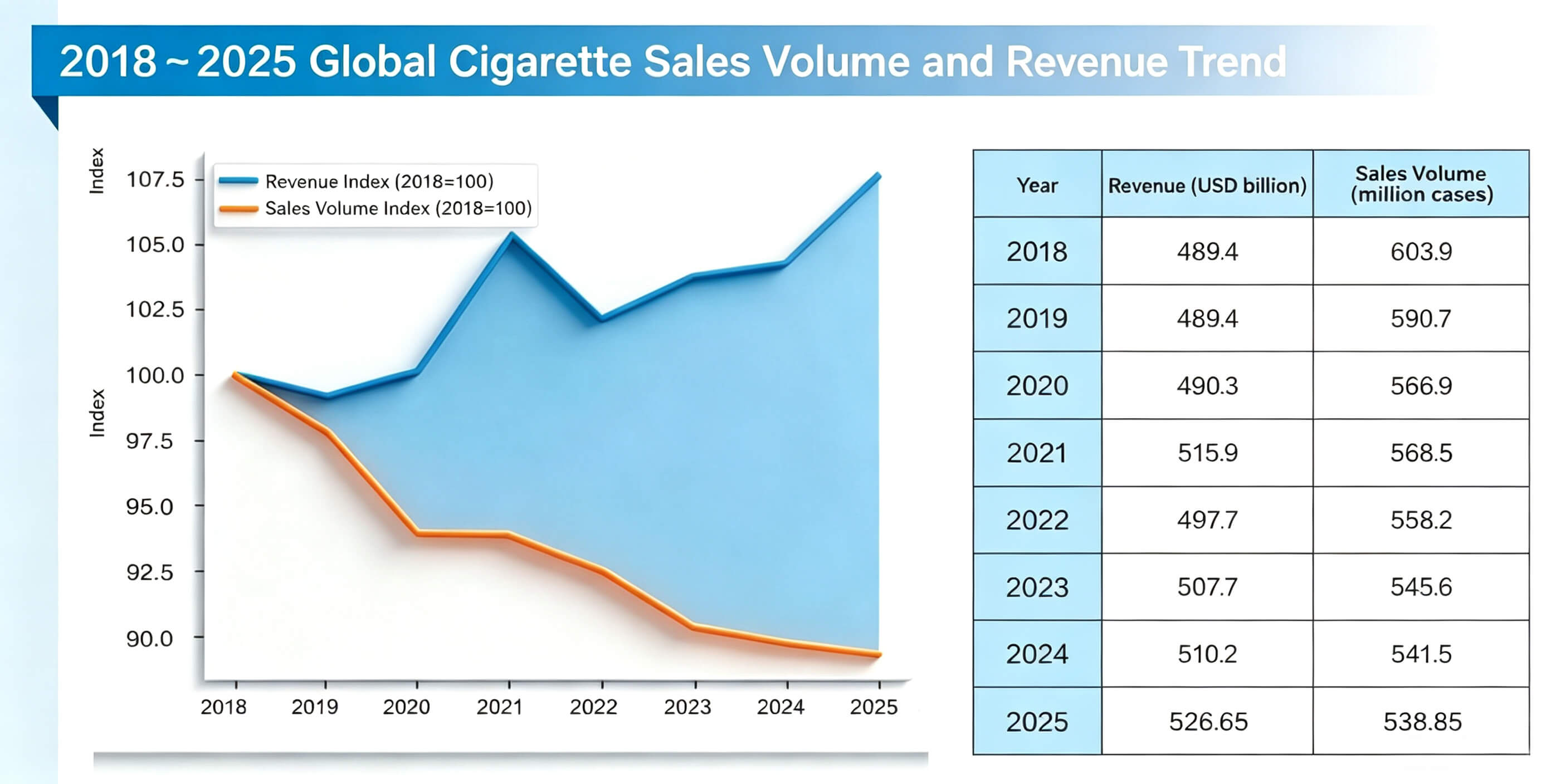
Hand rolled cigarettes sold 2.484 million boxes, a year-on-year decrease of 1.5%; The sales revenue was 28.76 billion US dollars, a year-on-year decrease of 0.5%. The weak trend in both quantity and price reflects its limited growth space as an "alternative category" in mature markets.
Illegal cigarettes continue to disrupt the market. In 2025, the illegal cigarette trading volume was 9.661 million boxes, a year-on-year increase of 0.3%, and the penetration rate rose to 15.2%, a year-on-year increase of 4 percentage points. The high permeability areas are concentrated in Latin America, the Middle East, Africa, and other regions. The countries and regions with illegal trading volume exceeding 500000 boxes include Pakistan (908000 boxes), Brazil (871000 boxes), India (639000 boxes), Indonesia (596000 boxes), Egypt (540000 boxes), etc. The countries and regions with a penetration rate of illegal cigarettes exceeding 50% include Ecuador (79.4%), Peru (60.7%), South Africa (59.7%), Malaysia (54.4%), the United Arab Emirates (53.4%), Pakistan (52.4%), etc. The increase in tax burden and the difference in regulatory intensity are squeezing some demand from the legal market to illegal channels, creating a dual pressure on the quality of compliant enterprise operations and the effectiveness of policy implementation.
2. New tobacco products: growth differentiation
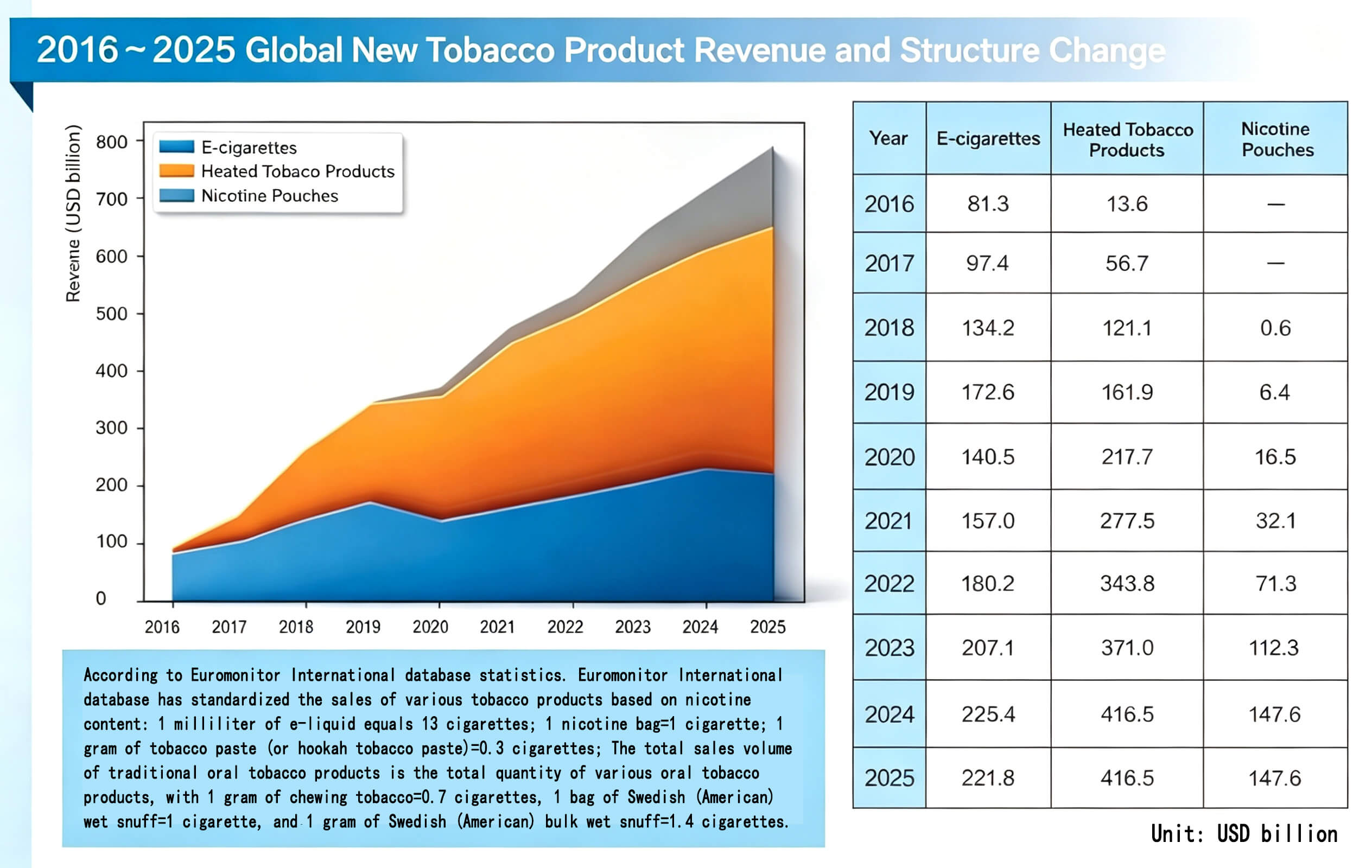
The total sales of new tobacco products account for 11.7% of all tobacco products. Among them, heated cigarettes account for 6.2%, vapes account for 3.3%, and nicotine pouches account for 2.2%. The growth trend of new tobacco products shows differentiation: heated cigarettes are steadily expanding, nicotine pouches are growing rapidly, and vapes are entering a period of adjustment.
The sales of heated cigarettes reached 3.886 million boxes, a year-on-year increase of 8.7%; The sales revenue was 41.65 billion US dollars, a year-on-year increase of 12.3%, of which the revenue from heating cigarettes was 39.09 billion US dollars. The market is concentrated in countries such as Japan ($13.09 billion), Italy ($4.9 billion), South Korea ($2.93 billion), Russia ($2.8 billion), Germany ($2.31 billion), Poland ($1.9 billion), etc.
vape sales amounted to 22.18 billion US dollars, a year-on-year decrease of 1.1%. Under the background of stricter regulation, vapes have entered the stage of stock competition and integration, and are significantly affected by policies. The top three countries in terms of sales accounted for a total of 43%, with sales in the United States reaching $4.78 billion, the United Kingdom reaching $2.4 billion, and Canada reaching $2.35 billion.
Nicotine pouch sales reached $14.76 billion, a year-on-year increase of 31.4%, making it the fastest-growing category for the year. The market is highly concentrated in a few countries such as the United States ($11.45 billion), Sweden ($1.01 billion), and the United Kingdom ($480 million).
3. Other categories: Overall stable
The overall stability of other categories. Cigars account for 3.4%, hookahs and hookahs account for 0.9%, and traditional oral cigarettes (wet snuff, chewing tobacco, etc.) account for 2.0%, with market share basically unchanged from last year.
The total sales revenue of cigars was 22.91 billion US dollars, unchanged from last year. The sales revenue of traditional cigars increased by 0.4% year-on-year, while the sales revenue of small cigars decreased by 0.8% year-on-year, and remained stable overall under price support.
Douyan and hookah sales reached 6.34 billion US dollars, a year-on-year increase of 7.6%, which is a highlight of growth for niche categories.
Traditional oral tobacco sales amounted to 13.83 billion US dollars, a year-on-year increase of 0.3%. The market is concentrated in countries and regions such as the United States, Sweden, Norway, India, and Algeria, exhibiting strong regional characteristics and dependence on consumer habits.
Regulatory Policy
In 2025, global tobacco regulatory policies will continue the trend of high-intensity control over traditional tobacco products, while regulatory focus will continue to expand to new tobacco products such as vapes, nicotine pouches, and heated cigarettes. From the perspective of regulatory situation throughout the year, policies in various countries have not shown a comprehensive tightening in a single direction, but rather multiple characteristics.
1. Category level: Based on traditional cigarettes, policy focus continues to extend to new tobacco products
Traditional cigarettes remain the foundation of the global tobacco regulatory system. In January 2025, the US Food and Drug Administration (FDA) proposed to reduce the nicotine content of cigarettes and partially combustible tobacco products to the lowest addictive level, which is one of the most powerful product standard proposals in recent years. However, this proposal has not been included in the government's priority regulatory agenda, and there is high uncertainty about its implementation. In terms of taste regulation, the US government announced the withdrawal of the long-standing ban on menthol cigarettes and further suspended its enforcement due to a federal court lawsuit. In terms of warning graphics, in September, the US federal court ruled that the regulation of printing graphic warnings on cigarette packaging violated the Administrative Procedure Act, and the related lawsuit was further extended. These repeated statements indicate significant political and judicial uncertainty regarding strict cigarette regulatory policies.
In 2025, vapes will still be a relatively concentrated area of tobacco regulation, but the regulatory focus has clearly shifted to channels and usage scenarios. France will pass a law in 2025 to completely ban the sale of disposable vapes, citing environmental protection and risks to youth use as the main reasons; Spain approves draft to include vapes in public places for prohibition; Ireland is discussing restrictions on vape vending machines and advertising displays; Poland has passed a bill to prohibit the sale of vapes and related products to minors and expand law enforcement powers; Iraq proposed a nationwide ban on vapes in the middle of the year. These policies indicate that the regulation of vapes has shifted from early product legality disputes to specific management of sales channels, usage environments, and target audiences.
Nicotine pouches are becoming a new regulatory focus. Due to significant differences in the classification of nicotine pouches, countries are still exploring the regulation of nicotine pouches. The regulatory approach in the United States is clear, regulating nicotine pouches as tobacco products. In January 2025, the FDA approved the launch of 20 ZYN brand nicotine pouches; In June, further launch the evaluation of its Modified Risk Tobacco Products (MRTP) and solicit public opinions; In September, the FDA launched a rapid review pilot program aimed at improving the efficiency of market access review. In Europe, in February 2025, France passed a law prohibiting the sale of nicotine pouches, while Poland included them in the protection of minors in its legislation; Finland and Italy have classified nicotine pouches as drugs, which were once banned and later lifted; The European Commission attempted to clarify the nature of nicotine pouches through legislation and regulate them through taxation, but it sparked controversy and has not yet reached a final decision. These events indicate that nicotine pouches have shifted from peripheral products to policy focus.
2. At the policy tool level, taxation, access, and law enforcement constitute the three main lines of global tobacco regulation
Taxation remains one of the most stable and widely covered policy tools in tobacco regulation in various countries, and countries such as Vietnam, Uganda, Pakistan, and the Philippines continue to promote tobacco tax adjustment or management strengthening. The significant change in 2025 is the expansion of the tax base towards new tobacco products and the strengthening of tax management methods. The European Union officially announced a proposal to revise the Tobacco Consumption Tax Directive in July, intending to include heated cigarettes, vapes, nicotine pouches, etc. in the scope of tobacco consumption tax collection; Croatia imposes its first tax on e-liquid for vapes.
In terms of product access, the United States' institutional promotion is the most typical. In March 2025, the FDA released an updated version of the Pre Market Application for Tobacco Products (PMTA) spreadsheet format, which explicitly requires companies to provide more standardized toxicology data, product consistency validation, and market impact assessment; In May, the FDA and the US Customs and Border Protection (CBP) jointly seized approximately 2 million unauthorized vape products at multiple ports, and identified that most of these products came from supply chains that had not passed PMTA review. These events demonstrate that the United States is gradually reducing the market space for non compliant products through a combination of "raising entry barriers+strengthening law enforcement clearance".
Law enforcement and channel governance will be significantly strengthened by 2025, becoming key factors affecting policy effectiveness. In addition to the large-scale seizure of illegal vapes by the United States, the Philippines conducted a surprise inspection of an vape production facility in May, seized about 3 million unpaid products, and filed criminal charges against related companies; Malaysia explicitly requires vape products to come with health warning labels in the new regulations, and imposes a maximum fine of 50000 ringgit (1 ringgit is approximately RMB 1.7) on non compliant retailers; Multiple countries have strengthened inspections and penalties on schools, retail terminals, and vending channels. These specific law enforcement incidents indicate that the regulatory focus is gradually shifting from rule making to implementation, especially in the field of new tobacco products such as vapes.
3. Regional level: The dynamic evolution of regulatory environments in the United States and the European Union is becoming more complex
In 2025, multiple judicial rulings, administrative personnel changes, and policy disputes will occur in the United States, leading to increased uncertainty in the short-term regulatory direction and the prospect of rule implementation. The federal court made a series of rulings within the year, forcing the FDA to modify its core enforcement processes. The FDA has also undergone internal adjustments and policy reassessments due to administrative changes, resulting in the departure of dozens of employees from the Tobacco Products Center, including former director Brian King. At the policy level, there has also been a shift, with the US government withdrawing or delaying multiple previous FDA proposals to strengthen tobacco regulation.
On the EU side, the most important development in 2025 is the initiation of discussions on the revision of the Tobacco Tax Directive, and for the first time, the inclusion of vapes, heated cigarettes, and nicotine pouches in the assessment scope of the unified tax framework. However, the proposal quickly sparked controversy and strong opposition from multiple parties. Opponents believe that the new directive may have an impact on the operation of the EU's internal market, specific regional economies, and trigger illegal trade. It is uncertain whether it will ultimately be passed, in what form of compromise it will be passed, and the specific implementation time.
Reference: 2025年世界烟草发展报告(上) -东方烟草网
Magix vape marketing team update china vape news, world vape news every day. Follow us for know learn more vape knowledge.